Wednesday, April 7, 2010

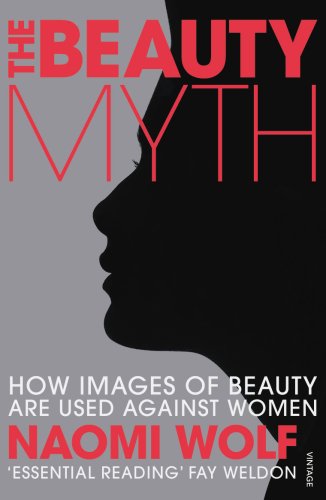
The Beauty Myth by Naomi Wolf.


So, this book blew my mind. I realize a lot of stuff in it is kind of dated (it was first published in 1991), and sometimes Naomi Wolf gets a little bit dramatic with her descriptions, but still. It's one of those things where I had some ideas about some of the things she talks about (everything from shaving to age to plastic surgery and in between) but this kind of threw all the facts connected to those ideas in my face. It pushed me to reevaluate my own beauty regimes, thinking about them in terms of what they take up financially and time-wise, and question all of them and why I participated in them. Was it all really for me or was it for everyone else?(and then I stopped shaving). One of the most shocking parts to me was the part about dieting where it basically lists off calorie counts for a bunch of popular diets and then compares then to the calorie intake of that of a starving person in a third world country - and they're pretty much all the same numbers.

The book is broken up into sections: work, culture, religion, sex, hunger and violence. Work delves into multiple court cases wherein women have been fired/harassed/basically whatever other bullshit you can think of for being too pretty, too ugly, too scantily clad, too modestly clad, etc. Basically highlighting that women have been given little to no options when comes to how to "dress for success". Culture expands on this idea of damned if you do and damned if you don't along with introducing the idea of Beauty Porn. Religion and sex of course goes further into the idea of everyone but women controlling women's bodies. Hunger mainly deals with diet culture and violence mainly with plastic surgery.

In a lot of ways this book to me was reminiscent of Backlash by Susan Faludi. It's kind of a thorough look at what the mass media tells us, what that means, what is the truth, and how everything looks if you try stepping back and looking at things logically. Pretty fucked up.

This is a little off topic but makes sense, I was talking with my friend about why in general, drag queens made more sense to us then drag kings. Drag in a lot of ways is playing up the absurdities of gender, and the way society wants women to portray themselves is not only completely absurd but totally alien, therefore it's easier to push these already absurd beauty regimes even further. A lot of this book was basically peeling apart different aspects of what female beauty is supposed to be in order to reveal how bizarre and a lot of times destructive it is.

So, though it was real depressing and kind of dated, it's had a pretty big impact on how I think about the idea of beauty and what it means.

Sunday, April 4, 2010

Stoner and Buchers Crossing

From what I've gathered John Williams wrote four books during the course of his life. Two of them, Stoner and Butchers Crossing, have been reissued by the New Review of Books Classics series. Although different in style and plot, both works center on the inability of male protagonists to achieve happiness through their ideals in an unrelenting, brutal world, which puts them in a better position then the secondary characters—-especially the female ones-- who Williams for the most part treats as inherently alienated without the prospect of achieving any ideals or happiness.


Stoner is primarily a book about alienation. It tells the life of a low grade Literature professor in a small liberal arts college in Missouri in the first half of the twentieth century. We see how the main character, John Stoner, holds onto his love of learning through the travails of a life that sees him alienated from his family, his wife, his daughter and eventually his job.
Although, some may read Stoner as championing the humanist ideal of learning, Williams actually complicates this by treating Stoner’s attitude toward literature, and the institution of university, as a refuge from the alienating forces of the ‘real’ world. A theme which is all too dated in our time with the privatization, rationalization and factoryialization of the university. (Just the fact that Stoner get tenure on the basis of publishing one book is anachronistic enough).
While I suspect this story will have little appeal to the readers of the Bumpidee reader, I highly recommend it. Williams fashions a riveting and affecting tale while achieving a perfect union of style, content and structure throughout with taught, well-crafted sentences and flawless transitions from one chapter to the next.


Butchers Crossing, on the other hand, is more ambitious in scope, structure and style. Williams uses the western genre to convey the themes of the quashing of youthful idealism, the elective affinity between the romantic idealization of nature and the domination of nature and the precarious and ruinous affect capitalism has upon human life.
Williams tells the story of a naïve Harvard student, who following his interpretation of Emerson goes west to live a life of self-reliance. Williams work incisively depicts how this ideal functioned in the context of manifest destiny and American capitalist imperialist expansion. To live his Emersonian ideal the youth funds a buffalo hunting party. Without ruining the plot the party slaughter an obscene and unnecessary amount of buffalo, fall prey to the cruelty of nature and get fucked over by the precariousness of the market. While many would end such a disillusioning narrative as one of realization—or the even more trite coming of age story—Williams leaves his characters traumatized, yet somehow still determined to carry on. A predicament, that sadly persists, which is why I recommend this excellent and illuminating work.

Tuesday, March 30, 2010

The Road by Cormac McCarthy


Yesterday I read the book and today I saw the movie of The Road. A parable is a story that teaches a moral lesson. Fruits of virtue are reaped when the moral endorsed by the parable is practiced. We know this and we know that the dominant parables throughout history aren't the ones that teach of the glories of cannibalism and rape but instead ones that lead to the simple joys of family life. The Road is a story of the latter kind. A latter day parable. And as such is familiar as it plucks the heart strings of all we hoped for or had as children. The joys of family life. It tells us if we keep trying we will enter back into the fold of the family but it will be bitter sweet to lose those we love. Bitter and sweet. But that the family and society must continue. Otherwise we will just blink out of sight like the million year old light of a million years dead star. And that would be...bad. The haunting image of the shopping cart from The Road lingered with me today in the grocery store. A George Romero-esque anti-consumerist shorthand or just a concise symbol of modern society? Either way, the shopping cart was a cool choice Cormac. (I thought I could get through the whole post without commas but I couldn't...let alone a whole book like McCarthy does!)

Monday, March 29, 2010

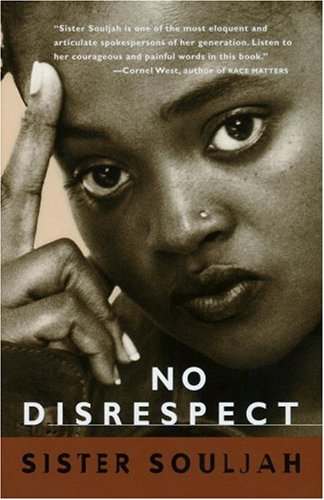
No disrespect by Sister Souljah

I've never been really all that certain who Sistah Souljah really was or what she really did. I've never read any of her books, I've never listened to her music. I know she said something during the LA riots which instigated some sort of  racial debate from Bill Clinton, and that I didn't even remember the details of until I looked it up again. Basically she in inconsequential to my life, so for me to read her memoir and be SO touched and SO inspired seems like a rarity.

This Book is an autobiographical look at a few of the more influential relationships that she had in her formative years, starting with her mother. She uses each chapter to better exemplify the love lost in the African American community. While, some of her sociopolitical philosophies I really don't agree with, her ideas made me feel strongly and examine my own experiences. 

 Her views on homosexuality seem completely ignorant to me.

  "....and even though she had chosen lesbianism for herself, she was still not happy. Nor could I be shaken from my belief that homosexuality, while perhaps offering some individuals relief from their pain, was nevertheless a way of avoiding our people's need to build strong , life-giving and enduring family structures, rooted in our original African culture...."   
In my experience, it seems to me that prejudiced attitudes and limited ideas about love is  what's really ripping family structures apart. Her values and morals lie in the bible and the holy Qur'an, both of those texts have historically been used to impose the interpreted morals of a very select group of people on a very large group of people. It's hard for me to feel that someone would limit there morality to the expressed ideas of a book in this day and age.
She also talks about "mixing races" and how she feels it's an ABOMINATION for black to be with white and vice versa. She touched on this quite a few times in this book. For someone like me, who actually comes from "mixed parents" I'm usually appalled at this mode of thinking. I've heard it before, it sounds like "ku klux krap" to me. But to hear it from her point of view made me almost agree with her especially when she talks about the emotional scarring of a mixed child and the lack of having a strong sense of self because you represent two different places. This is something that really hits home for me,  I'm the only person of color in my immediate family. What that means is while I was a child growing and changing into my body I started to realize that my body is different then everyone else that I'm close to. I also was the punch line to peoples racist jokes, and sometimes the victim of more violently motivated racism. This is because I stick out and I grew up in an ignorant white place. AND NOW I spend so much of my time as an adult justifying my worth and actions because I continue to live in a white and ignorant place.  So many times I've heard comments from people I consider my intellectual peers like "well, you're not that brown" or " just because that guy called you a nigger at that show that doesn't mean you need to be upset about it" and various other things. These statements are usually coming from white men who can easily dismiss these things because they've never had to really defend themselves against racism. And thats what I'm CONSTANTLY surrounded by, white men. Why? because I have a "white" family I've been socialized in a "white" place I'm still at the mercy of this "white" mentality. It can be devaluing and confusing when people in your immediate sphere belittle you're experiences with racism because they "see you as a peer" and they don't have those sorts of problems. This is the first time I've acknowledged that I do, to some degree, feel my self esteem would have benefitted being raised in a place where people looked like me and thought like me. But does such a place exist? I don't know ... but how glorious... a land of Nadias! I call it the princess dome. 
I think that separating the book into chapters that represent the people that touched her is so alluring.  You literally get to watch her grow from a scared and confused child into a self- loving woman. Even after all of the damaging relationships with men that she has, she still remains hopeful and still has love inside of her.  She is obviously a strong woman who, despite personal tragedy has made it her goal to better the lives of the people in her community and speak her mind. This is a powerful female role model. This is a brown feminist fairy tale where, the heroine saves the day and she doesn't find prince charming in the end, she finds out that she is a whole person.

Friday, March 26, 2010

Totally Wired by Simon Reynolds


Totally Wired was published last year, but I just got around to reading it now. As the front cover says, this is the "essential companion" to Reynold's previous book on post-punk, Rip It Up and Start Again, with "Post-Punk Interviews and Overviews." The best way to experience this book is to read it in segments. Pick a few interviews, skim the rest. Then when you have some time, really sink into it and read it from beginning to end. There is a logical sequence to the chapters, and so it helps to read them in order. But it's also great to read chapters randomly. There are interviews in the beginning and then some extra chapters with writings from Reynolds that weren't in Rip It Up and Start Again or are re-workings. Totally Wired works well by itself or as an extension of Rip It Up.

Having been a big NME fan in the late 1970s/early 1980s (I read it religiously every week), a lot of these interviews reminded me how much music - and music writing - back then was focused on trying to move music forward in new directions. The music mattered... and so did the ideas. There are often moments in music history when this happens. In this case, the explosion of creativity and innovation that leapt forth from the sparks of underground rock music, glam, free jazz, dub reggae, funk, electronic music, and punk in the 1970s pushed music into the future.

The peak post-punk years as Reynolds sees it were 1978-1984, and I'd agree. I definitely recall a huge transformation around 1978-79, when punk was morphing into something more experimental and atonal. The music still maintained the emphasis that punk had on short, basic songs that dealt with society or politics or everyday life, but the format of basic rock n roll or pop was subverted in different ways. As in Rip It Up, Reynolds makes the connections among proto-punk and no wave bands in the U.S. and post-punk bands in the U.K. But what's really interesting about Totally Wired is that it becomes clearer how there were commonalities among what various people were listening to or reading. It goes to show that there's a certain zeitgeist, with people in different places affected by similar things until it all coalesces in some way at a certain point in time. Or maybe that's the mythology Reynolds wants us to believe.

The interviewees include: Ari Up (Slits, New Age Steppers), Jah Wobble (PIL), Alan Vega (Suicide), Gerald Casale & Mark Mothersbaugh (Devo), David Thomas (Pere Ubu), Tony Wilson (Factory Records), Bill Drummond (Big in Japan, Zoo Records), Mark Stewart (Pop Group), Dennis Bovell (producer), Andy Gill (Gang of Four), David Byrne (Talking Heads), James Chance (Contortions, James White and the Blacks), Lydia Lunch (Teenage Jesus and the Jerks, Beirut Slump, 8-Eyed Spy), Steve Severin (Siouxsie and the Banshees), Nikki Sudden (Swell Maps), John Peel, Alison Statton (Young Marble Giants), Green Gartside (Scritti Politti), Gina Birch (Raincoats), Martin Bramah (Fall, Blue Orchids), Linder Sterling (Ludus), Steven Morris (Joy Division, New Order), Richard Kirk (Cabaret Voltaire), Alan Rankine (Associates), Paul Haig (Josef K), Phil Oakey (Human League), Martin Rushent (producer), Edwyn Collins & Steven Daly (Orange Juice), Paul Morley (NME), Trevor Horn (producer).

Read this book, and let it inspire you as it did me. Despite whatever you may feel about Reynold's writing, he does a great job of capturing the essence of what made post-punk music (and the music associated with it, such as art punk, industrial, synth pop) so liberating and meaningful. The fact that so much of this music is still influential or relevant to people today is proof of its lasting impact, beyond retro nostalgia. Sometimes we have to look back in order to move forward.

There are tons of great YouTube clips of these bands. Since the book is named after a Fall song, here's one of my favorite Fall songs to get you started: "Rebellious Jukebox" from their 1st LP Live at the Witch Trials..."I'm searching for the now"...


Tuesday, March 2, 2010

A Meaningful Life


Steve Dore lent me A Meaningful Life. It’s not the first time, and it won’t be the last time, he’s turned me onto something incredible.

In this case imagine a story that combines the misanthropic satire of Evelyn Waugh the rapid-fire humor of Woody Allen’s prose and a touch of French existential literature.

What you get is the story of Lowell Lake a totally banal married middle class schlub who comes to the realization that his job, his marriage and his life are totally meaningless. What’s his solution? Why, gentrify. Meaning buy an old mansion in Brooklyn (The book was written in 1971. Could we still imagine a modern version? I’m thinking of you Olympia Downtown Association) once owned by some ‘important figure,’ kick out all the people living in it, and bask in self-important reflected glow of owning and restoring a house someone ‘important’ once lived in. In other words, it’s no solution. But its fair to say the for the author, L.J. Davis, this is the whole point. And in the case of people like Lowell his satire is spot on.

Without giving away more plots details, the book also gives an entirely hilarious biography of Lake has plenty of amusing interactions between Lake, his parents, his wife, his in-laws (like I said Woody Allen) and others. It also has one of the finest endings I’ve read. Not quite Sentimental Education or The Stranger but pretty, pretty good.

Winter Music Round up

For some reason 4 out of the last 5 books I read had to do with musicians. I didn’t plan it this way. But that’s how it turned out.

The first two I read because of circumstance. I was in Portland and I was due to take the train back to Olympia for New Years Eve with nothing to read. While chasing Vinnie around the Buyolympia warehouse during a game of ‘monkey harvester’ (explained by Vinnie as follows: I’m the monkey, you try to get me ‘cuz you’re the monkey harvester.) I spotted a copy of The Go-Betweens by David Nichols. I bought it for the train.

A few days later in Olympia, I spotted a copy of the Neil Young biography, Shakey, in Adam and Jen’s guest room. I had heard a lot about, so I asked Adam about. He said it was good and he could have it.

Although I don’t really believe in biographies-- Adorno is right when he says that the "the peculiarity of the self is a monopoly commodity determined by society that it is falsely represented as natural," to which we could add in terms of rock bio's and romanticized the fuck out of-- I suspended my disbelief long enough to find both books interesting, probably because they were about artists I like. So I'd recommend them if your also a fan. (If your not I'd be interested to hear why you are reading them.) In terms of approach, focus, length etc, however, the two books couldn’t be different.


Shakey
romanticizes Neil Young and tells the warts and all story of his life and his music. The author seems to be a rather obsessive fan (which may explain why a lot of the book is about Young’s reluctance to interview him. Can’t say I blame him.) and the lurid, destructive and amusing details are painstakingly detailed. If you want countless stories about Young being a jerk to his fellow musicians, (or his fellow musicians being jerks like stills, Crosby etc.) the lowdown on what drugs were used for each of his records, interviews with Young's parents, extensive but unrevealing interviews with Young, or if you’re a really big fan who wants to read nearly 750 pages about Neil Young, then this books for you. If not, I can spare you the time and tell you the many amusing anecdotes about Young’s eccentric behavior.


In contrast to Shakey, The Go-Betweens is positively restrained. The book provides a straightforward account of the band and how the members made up the band, only hinting at lurid behavior, drug habits etc. He’s also a good writer with interesting opinions and who goes through the entire story of the Go-Betweens in about 250 pages. (Although in some ways this seems too short.) Unlike Shakey the book also emphasizes the contexts the individual members of the band came from, the scene the band emerged in and how their travels, producers, labels etc. influenced the band. In other words, unlike the figure of Neil Young, who admittedly seems to be a compelling sorta of weirdo, but who is treated like some type of wacko superman, the Go-Betweens are treated like interesting people who wrote some great songs.

The other two books about musicians I read were Bob Dylan and Patti Smith’s memoirs. Tobi already wrote an incredible review of the Smith book, so read that. If you still want my opinion afterward ask me in the comment section. The Dylan book was also amazing but I still have to think about it.

Wednesday, February 24, 2010

The Fallen: Life in and Out of Britain's Most Insane Group by Dave Simpson


All terms used to describe The Fall almost instantly seem redundant and slightly pointless. Unique, prolific, shape-shifting, inspiring. Yeah, yeah, yeah - we all know that about The Fall. And yet, we also seem to know nothing about The Fall. Are they a mystery. Or perhaps so ordinary and straight-forward they just appear mysterious. As if we are desperately trying to find an answer to a riddle, when there wasn't a riddle posed in the first place.

This is the problem Dave Simpson faced and this is the problem that drove him slightly mad in the process of investigating it. Because you can't really get to the bottom of The Fall. All you can do - as many, many, many ex-members testify to in the book - is hang on for the ride and appear bleary eyed at the end, wanting more. I've seen the faces of members on active Fall duty - at a DC club I worked at in the late 90s - a particularly volatile time for the band. It was not pretty. After the gig, I saw all the Fallers, except for Mark E Smith, sitting on the steps leading up to the stage, each occupying their own step, each with their heads in their hands as if they'd witnessed some horrible, life-shattering event. And yet none of the ex-members, interviewed in The Fallen, regret their time in the band and all would take up arms again if Smith asked them to rejoin. No matter what perceived cruelties of injustices they faced while in the band - each of them would go back for more.

Why? Who knows. Simpson likens it to a cult. All are treated brutally by their charismatic leader and all love him with unrestricted devotion. Again, this seems simplistic and add layers to The Fall mystery that probably don't exist. But there must be something about Mark E. Smith? As the book points out, he is the last man standing every time. Hardly any of the 50+ members of The Fall have gone on to do anything worthwhile musically, certainly nothing approaching the influence and impact of their former band. Yet the Fall trundles on, releasing album after album, still relevant and endearing, with only Smith as the original member. So it must be him. Mark E. Smith is, was and shall be The Fall and all others fall into line, serve their time and are then disposed of, fresh blood entering the fray.

I've always been interested in obligation and why people persist in continuing with creative endeavours when its obvious that they don't enjoy and it serves no purpose. So many bands have staggered on, hating each other, hating their audience, hating the music industry - but compelled to continue for various reasons - mainly ego-driven. I think Smith is interested in this to and has to constantly shake up The Fall to ensure the life-blood continues to flow. He might hate the people around him, the music industry and the audience, but he'll never hate The Fall because he, just like us, never knows what is coming next. His own mysterious behaviour ensures this.

Sunday, February 21, 2010

Feuchtgebiete (Wetlands) by Charlotte Roche


Woa. Last night I started reading Feuchtgebiete (Wetlands) by Charlotte Roche. It's a totally insane and amazing transgressive novel that was a best-seller in Germany and has recently been translated into English. The debates of erotica vs. porn really don't come close to encapsulating the total gross-out subversiveness of main character 18 year old Helen Memel's obsessions with bodily fluids and everything "disgusting" and "unfeminine" about sex and the female body. JD Salinger meets JG Ballard kind of approximates a description of the writing style, but really this is an irreverent, powerful female voice to rival Lydia Lunch or Kathy Acker or perhaps Lisa Carver. That said, it's not a politically radical text on every front. There is something here to offend everyone! As squeamish as I am about this kind of stuff, the book is totally making me squirm and laugh out loud at the same time. It's actually very funny. I have read 100 pages, so I can't assess the book in full, but I couldn't wait to post about it when I woke up this morning. Has anyone else read it? Here's a review I saw the other day.

Wednesday, February 10, 2010

Lucinella by Lore Segal


Melville House makes beautiful books, and not that many of them by women, so I was happy to pick up Lucinella, by Lore Segal, which is part of MH’s Contemporary Art of the Novella series. It’s a reissue of a book that originally came out in 1976. Lore Segal has written a few other books for adults (including one that recounts her experience fleeing Austria on the kindertransport to England during WWII) and some children’s books as well, including, I was pleased to discover, one of my old faves, Tell Me a Mitzi.Lucinella, the book’s protagonist, is a poet in early 70s New York. She attends Yaddo, the artists’ colony, and accumulates a group of poet/editor/reviewer friends (many of whom I imagine are meant to be satirical versions of actual literary figures, though I don’t know which ones). I could see the book feeling esoteric to those that aren’t in any way invested in that literary world, but I think that Lucinella herself is a compelling enough narrator to carry the novel, as she is alternately pained and elated by the writing process, friendships and love relationships, the state of her apartment, party chatter, mortality. There’s somewhat of a Jane Bowles quality to the writing—the way that Bowles characters speak in completely uncensored fashion, as if totally unbeholden to any recognizable social conventions, and the world sort of shrugs and goes along with it—not in a confessional way, but maybe a kind of frankness taken to the extreme. Lucinella’s observations about her friends and the world they all inhabit are also smart and often very funny: from the Contact paper salesman who has every possible variety of contact paper in the world except for plain white, to Lucinella’s chatter at a party at the house of a famous magazine editor: “I’m writing a poem about parties,’ I say, ‘which explains why we can’t simply say ‘Thank you, I’ve had enough of you and walk to go and talk to someone else.’”

Segal was also fascinated with fairy tales—she wrote some translations of Grimm—and that influence is present in Lucinella as well. Though the book takes place in the familiar terrain of New York apartments, department stores, Times Square, there is also a Yaddo poet named Zeus (hint: his wife’s name is Hera), and a scene near the end of the book where Lucinella scrambles up the pants leg of her estranged husband, and into his pants pocket (not to mention the appearance, about 2/3 of the way through the book, of a couple alter egos: Old Lucinella and Young Lucinella). I think Segal’s mix of the surreal and the mundane works because, in many ways, that’s what the process of writing is all about. It’s the intersection of the imagination—the stuff in your head—and the real world (the body you’re in, the geography, the people around you) that you inhabit when you’re writing. Lucinella at times reveals to the reader some self-consciousness about the writing process—“Notice how I elide my sentences and keep my books short. I’m watching for signs of a yawn”—but at the same time makes the case for the essentialness of writing, the ways in which it is such a part of her existence: “Writing is like brushing my teeth, without which the day is misspent.” In Lucinella we get to experience not so much the life of a writer, but the mind of one.

Saturday, February 6, 2010

I Change Worlds by Anna Louise Strong

Today is the anniversary of the Seattle General Strike, which took place February 6-12, 1919. Anna Louise Strong, a radical journalist who was involved in the action, wrote an autobiography called I Change Worlds: The Remaking of an American that is totally amazing. I didn't discover this book until I was in my mid-20's, and even then it was through an English friend (thanks Dale!). We were not taught this history in school and even though I had studied radical history in college and grew up in the Northwest, I didn't know about this book or remember her name. It's important to keep the history of dissent alive and remember the women who came before us. It's also inspiring to read about an anti-capitalist labor movement shutting down an entire city. It makes me wonder if something like this could happen again. People say the Battle of Seattle is proof that radicalism and resistance is still alive, but that was more than 10 years ago. What is happening today? I'm going to study Howard Zinn for ideas.

Thursday, February 4, 2010

Girl Power: The Nineties Revolution in Music by Marisa Meltzer


Girl Power traces the influence of OG "riot grrl" groups (Bikini Kill, Bratmobile, Heavens To Betsy) to the Spice Girls, covering "foxcore", Sleater-Kinney, Le Tigre and Ladyfest as well as several other pop stars and other all-female alternative/indie rock groups along the way.

The book is written for a mainstream audience and suffers from some of the awkwardness that comes along with trying to explain this stuff to the general public. Marissa comes across as a former indie-rocker who felt she didn't really fit into the punk scene, yet was invigorated by the feminism (and celebration of girlhood) that happened during riot grrl. This makes sense, as she admits she found out about the movement through Sassy (her previous book is a love letter to the pro-girl teen magazine) She argues that riot grrl's "media blackout" led to its demise and wishes that the original groups would have stuck around and tried to find a larger audience. Describing an experience of seeing Sleater-Kinney play to 13,000 people, she recalls wishing that riot grrl had been able to sustain itself. Paradoxically, she acknowledges that, while the Spice Girls were cool in some ways, their "girl power" was limited to marketing and questions what that means in terms of empowerment. Quoting Kathleen Hanna, she points out that buying a Spice Girls notebook is not going to change the world. This makes me wonder what would be different if it had been Bikini Kill notebooks the girls were buying.

I knew Marissa around 96/7 when she lived in Olympia and had a cute all-girl accapella group called The Skirts. In the interest of "full disclosure"--I was a big Skirts fan and she was my favorite member! It was a weird time period. It was interesting to read her take on things as someone who admits (somewhat reluctantly) that she moved here to go to Evergreen after getting into riot grrl and even "semi-stalking" Kathleen. I wish she would have told more of her own story here. Her voice comes through loud and clear when she is critiquing what she calls the elitism of independent culture. She belongs to the camp that believes that it's exclusive to play basement shows, failing to see how this can be a more inclusive model. By booking our own tours and creating a DIY feminist network through the mail, Bikini Kill encouraged girls to meet each other and start their own scene. Sure a "scene" can be clique-ish and Olympia was/is no exception, but the idea we were were working with is that if we can do it here, certainly you can do it where you live. Only a few bands can get on MTV or sign to a major label. It's far more populist to encourage kids to put on shows where they live and take their own work and friends seriously. To her credit she does acknowledge that Ladyfest was a successful attempt to take this idea to another level.

I was interviewed (via email) for the book and am quoted a lot, which is kind of embarrassing, as I don't think what I'm trying to say really comes through, which is partially my fault, not thinking about who the audience for the book would be and just neurotically rambling on to her about how strange it is to have been a part of something that had such a big cultural impact. I remember telling her how weird and hard to talk about a lot of this is for me without going into a lot of detail. I tried to explain my perspective. On the one hand you want to take credit for your work, especially because women are encouraged NOT to take credit for anything. On the other hand, it's embarrassing. Sometimes I feel like I'm lying when I talk about this stuff because what actually happened is so surreal and bizarre that I often have a hard time believing it myself.

Personal weirdness aside, I think it's cool that someone wrote this book for a mainstream audience. My hope is that teenage girls and young women who don't know this history will get inspired to find out about riot grrl. It would be really cool if it inspired girls to create a new young feminist movement rooted in their generation.

The book made me think a lot about documenting history from a strategic perspective. How could this story be told to incite participation in girls? A big part of the original "girl power" idea, was to get girls to stop being consumers of male-dominated culture and start producing our own. I guess my fear is that this kind of pop-culture history could encourage girls to simply consume "girl-culture", thereby claiming the identity of "riot grrl" or "feminism" through the act of buying a record, as opposed to starting their own band or fanzine or putting on a show. To me the point is to encourage girls to start their own young feminist movement, not just to copy what we did. That is the danger of nostalgia I think...

So I'd be interested to hear what people think about this. How can we tell our story without feeding into this consumer-oriented nostalgic trap? Or is that inevitable?

Tuesday, February 2, 2010

Remembering Phyl Garland


I didn't know that Phyl Garland, who wrote The Sound of Soul: The Story of Black Music (1969), died, back in 2006. I didn't know too much about her, but have always appreciated the research she did on women in soul and thought she was an interesting writer.

In 1981, Phyllis Garland became the first African American and first woman to earn tenure at the Columbia University Graduate School of Journalism.

She loved jazz, ballet and soul music and believed deeply in the power of the arts. She taught her students to cover them as thoroughly as they would city hall.

Ms. Garland, a native of McKeesport, died Wednesday of complications of cancer at Calvary Hospice in Brooklyn. She was 71


In addition to teaching journalism, she was the editor of EBONY (The New York Times says Essence Magazine but I think they got it wrong) for several years, had an extensive music collection and sang at her own retirement party with an all-girl band backing her up.

The Sound of Soul is one of the only full length books about popular music (that I know of, there may be more) from this time period written by a woman. It's not that hard to find if you look in used bookstores. Nice cover too. I couldn't find a picture of it online.

Sunday, January 31, 2010

The Last Secret by Mary McGarry Morris


The Last Secret is a thriller that is supposedly well-written. It got good reviews and the author is critically acclaimed. The story centers on Nora, who works at a newspaper and has a couple of kids and a successful husband. From the fact that she has a career and a family (I guess) the reader is supposed to think her life is perfect (according to the reviews) but from the very beginning of the book, her life and sanity is shattering into shards.

I found the structure of the book to be confusing and the writing a little distracting and hard to follow. It starts off describing a violent, sexually charged week of her life as a rebellious teen and quickly moves forward to the present day. Nora is middle-aged, her marriage is crumbling and her kids are suffering. Her husband has been having a relationship with his best friend's wife, who happens to be her best friend and his ex-high school sweetheart. The story then unfolds mainly from Nora's point of view, which is highly fragmented, panicky and full of self-loathing. The other perspective is that of a sociopath from her past who has resurfaced named Ed. His misogyny mingles with her self-hate and vulnerability to paint a disturbing picture of victimization that is pretty convincing.

I kept wondering if people are really this surprised when their middle class, suburban life--career, marriage, nice house, two kid--fails to sustain them. I find that hard to relate to but I suppose I shouldn't. The book does a good job of contrasting appearances with psychological pain lurking underneath the surface. As far-fetched as the plot would seem if I were to write it down on paper, The Last Secret is believable up to a point, which makes me wonder why, and have some degree of respect for the storytelling. By the end of the book, things are both totally unbelievable and simultaneously predictable. Plot twists reveal "surprises" that are easy to see ahead of time and things become more like a daytime soap opera. The "last secret" is apparent early on, making its revelation anti-climatic. Everything else that happens after that point seems sensational and hard to take.

In the sense is that it's a dystopian novel, it kind of works, but also feels cheap and emotionally manipulative, like a Hollywood movie. Thematically it reminds me of The Corrections by Jonathan Franzen, which offers a dark, depressing take on the American middle class, but gives the reader no hope or reason to care about what happens to his characters. The Last Secret feels empty in a similar way. The characters don't seem to have any depth to them. At best it's a modern day Gothic American tale, grotesque and strange yet familiar and mundane. The incestuous small-town feel the book conveys is realistic--lives are too intertwined and there is no way to be sure of who knows what or where anyone's loyalties lie. At worst its a melodramatic, goofy murder story about wife-swapping and keeping up appearances that drowns itself in a swirl of shame and loathing. There's also a quasi-religious side-plot that is a little heavy-handed. The theme of "respectability" didn't really engage me. The theme of self-deception was far more intriguing.

I didn't like it very much, though I was compelled to finish it because I wanted to know how things were going to turn out. By the end I was pretty disappointed and happy to be done and move on to the next library book. I also think it could have been about 50 pages shorter. I probably won't read any more of her books.

One-Dimensional Woman


One-Dimensional Woman, by Nina Power- a philosophy professor and blogger- is an incisive work of feminist cultural critique. Power’s book makes important connections between mainstream trends in feminism and contemporary capitalism and raises important questions. It also reminds me of The Baffler with its compelling use of academic theory for compact, lucid, trenchant and hilarious screeds against mass culture, ideology and contemporary capitalism.

An example of these elements can be seen in the way Power frames the underlying issues of the book:

“Did the desires of 20th century woman’s liberation achieve their fullfilment in the shopper’s paradise of ‘naughty’ self-pampering, playboy bunny pendant and bikini waxes? That the height of supposed female emancipation coincides so perfectly with consumerism is a miserable index of a politically desolate time. Much contemporary feminism, however, particularly in its American formulation, doesn’t seem too concerned about this coincidence and this short book is partly an attack on the apparent abdication of any systematic political thought on the part of today’s positive, up-beat feminists. It suggests alternative ways of thinking about transformations in work, sexuality and culture that, while seemingly far-fetched in the current ideological climate, may provide more serious material for a feminism of the future.”


Power moves to examine these issues from the perspective of two stated contentions: (1) “I contend that much of the rhetoric of both consumerism and contemporary feminism is a barrier to any genuine thinking of work, sex and politics…what looks like emancipation is nothing but a tightening of the shackles” (2) One-Dimensional Woman starts from the premise that we cannot understand anything about what contemporary feminism might be if we neglect to pay attention to specific changes in work and the way in which ‘feminism’ as a term has come to be used by those who would traditionally have been regarded as the enemies of feminism.” Both reflect the underlying viewpoint and methodology Power utilizes through out her work; post-humanist Marxism. (what I mean by this will become clear below)

The first few sections provide evidence of Power’s first contention. Her chapters on Sarah Palin and the Hawkish and Mawkish use of feminism to condone the invasions of Afghanistan and Iraq, show how this appropriation of feminism unites the “imperialist language of liberation with the techniques of war.

Her later chapters on labour puts forward a compelling counter-argument: rather then work liberating women, neo-liberal labour has turned the male and female workforce into behaving according to traditionally feminine character traits by annihilating the division between work and free time and forcing you to function in your every waking hour like a pliant, flexible, constantly networking constantly advertising, perky resume for your occupation.

Power further argues that this type of work has extensive consequences for how women relate to their body as well as feminist critiques based on the idea of objectification. Since, Power argues, your body has become has become a cv, “Girls Gone Wild” is paradigmatic of neo-liberal labour which has pernicious and insidious consequences for subjectivity. In work, then, you;


“give up something obviously crap in exchange for a kind of performance that reveals that there is nothing subjective, nothing left, hidden behind the appearance, that you simply are commensurate with your comportment in the world. You are your breasts.”


Consequently, Power argues that many contemporary women always already objectify parts of their body, viewing them as wholly separate entities. This causes here to raise the question “whether the language of objectification is still useful because it depends on a minimal subjective dimension which may no longer exist in the modern world with no separation between the private world and the job” So, that “if feminism is to have a future, it has to recognize the new ways in which life and existence are colonized by new forms of domination that go far beyond objectification as it used to be understood.” (here is the post-humanism, questioning whether a substance known as human nature exists below this colonization)

Power offers some of her own suggestions for the future of feminism through film. She proposes identifying candidates by offering the following grounds: does it have at least 2 women in it? who at some point talk to each other ? about something besides a man, marriage or babies? Which leads her to compare Sex and the City, which she characterizes as a sort of consumerist quasi-religious film about searching for “The One”, with Daises, which is of course amazing. She also advocates revisiting the potential of early pornography with its liberatory notions of bodies, sexuality and possibility as a contrast with the modern porn industry and the sexuality of hyper-capitalism.

She concludes, by restating the importance of feminism has for showing the connection between household labour, reproductive labour and paid labour and argues that contemporary feminism should re-invision how the three relate along the lines of Firestone’s The Dialectic of Sex.

In all, I found One-Dimensional Woman to be entertaining, provocative and illuminating. While it is true that the critique’s Power offers are far more fully fledged then her proposals (although to be fair this is a defect of the school of philosophy she is working in) and her targets only focus on what are perhaps the most egregious easy targets, I still find myself in full agreement with her contentions and premises and intrigued by her proposals. As Power uses a wealth of other scholarship, One-Dimension Woman is also a good resource for further reading.

Saturday, January 30, 2010

Just Kids by Patti Smith


Like Bob Dylan's Chronicles Volume One, this is a remarkable book for us longtime fans and I hope it is merely the first volume in a longer series of memoirs. Patti Smith the poet, rock-n-roll star, mother, artist, icon, rebel, myth maker and performer gives us her own coming-of-age story the way only she could have told it. Wow. To sum up what she says would be to deny you the pleasure of how she says it. This is her first prose book and mostly covers the period in her life from 1967-1973, when she was photographer Robert Mapplethorpe's best friend, lover, muse, co-conspirator and partner-in-crime. It's a love story that celebrates the miracle of finding each other at the exact right moment in time and making the most of it, living as fully as is possible on very little means but a lot of determination and sheer will, which takes the form of desire as well as desperate need.

I particularly enjoyed reading the cultural history--they lived on the streets of New York City in the summer of love, ended up in the Chelsea Hotel with leftover from the 50's beat poets and Woodstock era rock-n-rollers, hung out at Max's Kansas City on the fringe of Warhol's fading Factory scene, knew theater people from Penny Arcade to Sam Shepard--their work led them to the high society art-industry and the underworld of CBGB's respectively. This is all well-documented and /or made mythic here, depending on your interpretation of the book. You can expect cameos by Jim Carroll, Richard Hell, Tom Verlaine, William S. Burroughs, Allen Ginsberg, Harry Smith, Jimi Hendrix(!), Grace Slick, Bobby Neuwirth & Janis Joplin to name but a few…

Another thing I liked about the book is how it covers the economic reality of being an artist and having no money. It describes the daily situation of what that was like in this time/place in lucid detail: the hunger pains, the shoplifting, the shitty jobs, unemployment, the shared sodas and hot dogs, bad diner coffee and late night donut shops, the alleyways, fire escapes and park benches--you will recognize the daily hustle of the punk--the artist as scavenger...as gleaner...as thief.

But the most fascinating part of Just Kids is Patti Smith's riveting re-assemblage of their personalized iconography and shared aesthetic universe. From Blonde on Blonde and the French symbolist poets in Patti's case and Midnight Cowboy to Michelangelo in Robert's--this is a meticulous inventory of their inspirations, visual & literary obsessions, hang up's, hang out's, freak-outs, textures, trinkets, wall-hangings, record & book collections, loft-apartment dwellings, (separate) pilgrimages to Paris/San Francisco --providing the reader with a fleshed-out, clear aesthetic lineage of their lives as insurrectionary artists who were gripped by influences both "high" and "low" and were able to fuck shit up, in the best sense of what that can mean. From how they moved and talked to what they wore and how they held themselves on the street, the way they lived their lives and what was important to them carried itself into their work, which in turn, ricocheted in the culture, changing the world we live in. Study this as a road map of two people who took the raw material of their lives seriously enough to live as if what they did mattered--it is the story of two artists who made work that mattered. Their art is the record of this commitment, to themselves, to each other and ultimately, to the world.

Oh yeah, I guess it's not too much of a spoiler to tell you that this is also a truly sad book, as Robert Mapplethorpe died of AIDS in the late 80's, but in my view this gives the book urgency despite the life-crushing sadness that it must have brought to those who knew and loved him. To live anything less than a full life in the face of such as tragic loss…well that is the struggle we all must contend with in this world on a daily basis…that is mortality, the conditions under which we all live. (for some, like Patti Smith, this is a religious matter, but for me it is merely existential...) At any rate I find Just Kids life-affirming despite its documentation of deep, dark despair.

This is a truly awesome work. It will give you the ammunition you need to fend off the square "hipsters" in our midst. I hope young people take it to heart and I know those of us who have been around the block will be sustained by this for years. Use it as rocket fuel...space is the place…the transformation of waste...it's right here, man. Let it surround you and become your daily imperative to create. In the immortal words of punk rock patti smith "I step up to the microphone and I have no fear".

Thursday, January 28, 2010

Intersex (for lack of a better word) by Thea Hillman


please read this first:
http://www.isna.org/faq/what_is_intersex

This is one of the most honest memoirs I have ever read. Hillman writes with natural courage about her experience and her criticism. She is queer, Jewish, feminist, and intersex, for lack of a better world. She lives in SF and recounts her formative life in this past decade. I started reading this book right after i got my heart broken twice.. and was not getting any action. i only mention this because there is a lot of action in this book. Thea likes sex, and sex parties and fucking. So at first i was a little put off and feeling left out, like why do i live in oly instead of sf... but i'm over that now.

I wonder how i would move if my gender didn't fit into binary gender. What would it be like to live in a world that is marked w/doors (physical and other wise) male/female, and not fit what is assumed as being male or female. Reading Hillman's memoir made me reconsider my own thoughts on gender and the presumptions i make about others' sex.

http://www.isna.org/

Sunday, January 24, 2010

Edith Wharton

I got this Edith Wharton anthology for Christmas. I am reading it this morning but who knows how far I will get. I don't think I've read her before, but I'm not sure. I feel like I read Age of Innocence, but I may have just seen the movie. It's good by the way.

Wish me luck! So far it reminds me of George Eliot.

Saturday, January 23, 2010

Trouble by Kate Christensen


Earlier in the week I read Trouble by Kate Christensen. I actually think this was a little better than Commencement, though similarly cringe-inducing at times but you can't tell it has any redeeming qualities by reading the promo blurb, which sums up the action as follows:

A vibrant story of female friendship and midlife sexual awakening from the acclaimed author of The Great Man

Josie is a Manhattan psychotherapist living a comfortable life with her husband and daughter—until, while suddenly flirting with a man at a party, she is struck with the sudden realization that she must leave her passionless marriage. A thrillingly sordid encounter with a stranger she meets at a bar immediately follows. At the same time, her college friend Raquel, a Los Angeles rock star, is being pilloried in the press for sleeping with a much younger man who happens to have a pregnant girlfriend. This proves to be red meat to the gossip hounds of the Internet. The two friends escape to Mexico City for a Christmas holiday of retreat and rediscovery of their essential selves. Sex has gotten these two bright, complicated women into interesting trouble, and the story of their struggles to get out of that trouble is totally gripping at every turn.

A tragicomedy of marriage and friendship, Trouble is a funny, piercing, and moving examination of the battle between the need for connection and the quest for freedom that every modern woman must fight.


I enjoyed the beginning of the book, where the therapist knows she is going to leave her stagnant marriage (and child) behind after flirting with a despicable man who she knows sucks and does not actually hook up with him. I could relate to it I guess. The books is mid-life crisis-y in theme and about three female college friends who met at Reed College (sound familiar) and are at very different points in their lives, struggling with female friendship, society's prescribed roles for women and their own desires.

Spoiler Alert:

What ends up happening is kind of bogus. When Josie decides to meet her rock star friend Angeles in Mexico City to get away from it all, she is punished for enjoying herself within the narrative. At the exact moment she gets to have awesome sex for the first time in years, her best friend (who has relapsed into heroin addiction after being much maligned as an unattractive, over the hill has-been by the tabloids) decides to take her own life. Message: older women in the music industry will not be able to survive and older women who leave their husband and kid for sex are just being selfish and deserve to suffer. I guess this could be read as an accurate portrayal of women's lives under patriarchy but it comes across as melodramatic and contrived. Does someone have to die for a woman to have an orgasm? I hope not! At this point the book becomes a total let-down, if the "glamorous" idea of first-worlders vacationing in Mexico didn't turn you off already, not to mention some of the self-aware "essentializing" of the locals. This was presented as commentary on neo-colonialism, but I would argue, also worked to reinforce it...same goes with all of Josie's white-guilt and internal dialogue/conflicts about stereotyping people she meets.

I actually kind of couldn't believe how cliché the climax and resolution was. It's like, how do people get away with this stuff? This one also made me wonder what I am looking for by reading this kind of "chick-lit" where the characters are dumbed-down and vacant and the authors have little if anything to reveal about the world, despite their efforts to try and describe it. The main thing that bugs me about both Commencement and Trouble is that they are somehow, by default, seen as representing the modern woman or something. The assumption being that we can all relate to the lives and struggles of the characters.

Moving right along, I finished the last Sandra Scoppettone novel in her Lauren Laurano series this afternoon and have been thinking of comparing it to George Pelecanaos' Derek Strange series. Both are five books set in a location, based around a detective. So we'll see how that goes...in the meantime there are a few more books I recently read so I'll try and get to those first.

Friday, January 22, 2010

Commencement by J. Courtney Sullivan


I read Commencement by J. Courtney Sullivan this week. I must have put it on hold over the summer after reading a review, not sure.

On one level this book grossed me out. By focusing on four women who meet at Smith College, an elite all-girls school, it presents an upper middle class/rich, white American version of young womanhood as "reality"...I guess that is "reality" for some of us...but what passes for sisterhood in Commencement isn't Feminism with a capital "F", despite Sullivan's lack of consideration of how the rest of us live.

The author also sort of perpetuates sexism in hard to pin down, insidious ways. To get specific with one example, she has her characters talking about the other characters bodies (students gaining weight at an all girls school and wearing PJ's and sweat pants to class because there aren't any guys around) in ways that normalize body image issues and reduce women to their appearance. This is catty and also hetero-normative by assuming that women only "let ourselves go" when men are absent. Ok maybe she is just being descriptive here, but there doesn't seem to be an awareness of the issues. It made me feel neurotic that I was supposed to identify with the young characters hating other women's bodies or something. She didn't make it clear that this was the point of view of the characters. It came across as the point of view of the author. There is little if any consideration of how this rejection of patriarchal norms might be positive or liberating, it's just made fun of and dismissed. It seems like this is Sullvan's ill attempt at humor, the assumption being that the reader is well-versed in the kind of self-depreciating humor that so often thinly disguises female self-hate in the public sphere. (An interview with the author seems to confirm this, as she jokes with a reporter about how she didn't wear make up or concern herself with her appearance while at Smith.)

The basic premise of the book is classist. The generation of young women the characters belong to is described as being the first where women had access to (perhaps too many) choices. Well I hate to bring this up, because it's outside the scope of this fictional reality, but it is only a very, very small portion of the world who have these choices, and within that group there is racial diversity/hierarchies and all kinds of economic factors that complicate the choices of "career" vs. "family" or whatever. Secondly, individual choice is a Western value and not necessarily a sign of progress or an indication of a more advanced society. There are multiple feminisms, but the only kind depicted within Commencement is white, middle class and Western.

To her credit, Sullivan tries to talk about issues that impact poor women, such as sex trafficking, prostitution and urban poverty. Unfortunately she does this without allowing any of these women to have much of a voice within the narrative. No women of color in the story become real characters in the book. Out of the two I can think of who are given names, one is a victimized prostitute and another is a girlfriend whose voice we never get to hear--both are objects rather than subjects.

The interesting part of the plot focuses on April, an activist who is under the spell of a renegade star feminist who exploits her in an unsuccessful attempt to "save" trafficked women. Predictably, this becomes just another rescue narrative of a white woman trying to save the world. It's too bad Sullivan didn't use this storyline to give some of the "rescued women" center stage. Instead we get to see a victimized woman betrayed by a radical feminist with good intentions. Because the radical plan backfires, radicalism fails, while mainstream feminism (one of the main characters works for NOW) rises to ascendancy with the book's sudden, unremarkable yet awkwardly unresolved ending.

Less interesting story-lines focus on one woman's struggle with her own emergent lesbianism/bisexuality (Bree), another's alcoholism and in general flakiness/dissatisfaction (Celia) and a third woman's loss of her mother to cancer and need to find security/family (Sally). If it sounds a little like a soap opera, then you get the picture. Lots of melodrama and sentimentality.

I did like reading about four women who become close while they are away at school and struggle to prioritize their friendship after college. I guess I felt a little jealous of this supposed "universal" reality, as not only was I never sent away to a prestigious school at 18, but I was told I had to live at home if I wanted to go to school or else figure out a way to live off campus and pay my own rent. I know I was lucky that my parents were willing and able to pay my tuition but this situation meant I ended up quitting school until I could afford to pay for it myself, working my way through college as an adult by taking night classes over the years. So I guess on some level I wish I got to experience the going-away-to-school and living-in-a-dorm thing, but not really...because going on tour and playing in bands sounds a lot funner, not to mention realistic. Plus going to night school with working adults provided me an education I would never have gotten at an Ivy League/ish school. I know that if I wrote a novel it would have a solid class analysis for example and hopefully it would be a little more in touch with the way most people live. Anyhow, this world is just not the world I grew up in. None of my high school friends went away to college, I never hung out in the dorms (except in high school I'd go to parties at Evergreen occasionally) and I have no idea what this world of elite, bizarre ritualistic student life is all about. From what I gathered from reading this, it's a little like Harry Potter, but with a lot of same sex making out and crying.

Mostly this book, like bad TV, is mainstream, boring and cliché. It made me realize I need to try harder to find contemporary authors/books...that I shouldn't rely on the New York Times so much. This post-sex-in-the-city world of the professional woman who is really concerned with the fact that she has rich friends and she herself is not rich (yet) is just materialistic and depressing. I realize some women live in this world, but that doesn't mean this is "the real world". It's a very limited, privileged view and these depictions are subsequently damaging. They further mystify and universalize. They perpetuate values that make things worse. But worst of all they have nothing to say.

Besides all of that Commencement is just kind of goofy and not very well-constructed. The story starts with a wedding and the climax is a woman giving birth. Ok, get married, have a baby, even write about pregnancy/ having a baby. That is universal enough I guess given that most women have children and all of our mothers gave birth to us at some point, but really as a metaphor or point of drama, it's kind of obvious and corny.

Confession: I did stay up until 4AM reading this so I guess it's entertaining or maybe I just have a problem and get some kind of weird indulgent pleasure reading badly written "feminist" fiction.