
Showing posts with label Doris Lessing. Show all posts
Showing posts with label Doris Lessing. Show all posts
Monday, May 21, 2012
Summertime by J.M. Coetzee

Friday, August 14, 2009
The Good Terrorist by Doris Lessing
Hello Bumpidee Readers. Maybe you are too busy reading to post anything this summer--I know I have been, particularly in the past month or so. I just finished this one:
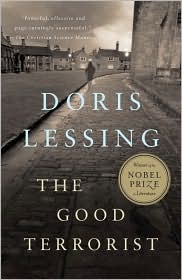
Written in 1985, The Good Terrorist takes place in a communist squat in London during the Thatcher Era. The plot centers on securing the house as a legal squat and dealing with the mundane day-to-day workings of the household, as well as the tensions between the different group members and their politics and what it is they are really prepared to do for 'the revolution'. They are living in the Cold War era and dealing with possible 'Russian Spies' as well as the I.R.A.
The main character, Alice, is presented mostly from the exterior. Unhealthily obsessed with her annoying 'revolutionary' partner-in-crime kind-of boyfriend Jasper (who actually seems to be gay), Alice does all the 'women's work' and much of the work in general. In this way, the author presents the reality of sexism and women's relationship to the 'left', which is pretty convincing and realistic. Because her character is very realistic--not heroic, nor a victim--and is presented through her actions--generally work--there is a distance created between the reader and the normal process of 'identifying' with the main character.
As I read the book, I kept thinking --'this is so not written by an American writer' and was reminded of films like Chantal Akerman's Jeanne Dielman and Blow Up My Town, as well as Bertold Brecht. Works of art where the point of a narrative is not to create a character the reader can 'identify with' or even like, but rather encourages a distance where analysis is encouraged, specifically surrounding issues of gender and work and economics. Jean Luc Godard also does this...so does Robert Bresson.
I also thought of European existentialist novels I have read, such as Nausea by Jean-Paul Sartre, The Stranger by Albert Camus and The Trial by Franz Kafka. At times I wondered if Lessing was influenced by Simone de Beauvoir's The Mandarins at all, but if so I think Lessing is a better writer from a craft-of-writing point of view. I was also reminded of the few Russian writers I have read, particularly Dostoevsky--thinking a little bit about Crime and Punishment in particular.
I won't tell you what happens or how I felt about it, because mostly it just made me think a lot about the themes addressed. It is a compelling work-- I thouht a lot about how writers employ different narrative techniques for various ends. Her command of language and vivid power of description really sunk in with this book. I was really impressed by how well the story was put together. The way it unfolded felt really inevitable. It was very much like a film, totally suspenseful--once I got into it I couldn't put it down--it came across like a thriller or a mystery without feeling manipulative or cheap.
All this convinced me that Doris Lessing is a master crafts person. I was left wondering why she wrote this particular book at this time. I don't really know what her politics are (even though I did google her) but she made most of the characters seem naive and a little ridiculous by the end, though really nuanced and (humanly) flawed in ways that could come off as cynical to a younger person but appealed to my current frame of mind. I liked how ultimately the characters exist in relation to their class backgrounds and how she has Alice's "bourgeois" mom come in at the end and really bring reality back into the picture.
Saturday, November 15, 2008
The Golden Notebook by Doris Lessing
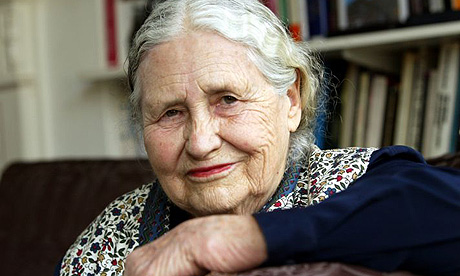
Read Nobel Prize winning author Doris Lessing's classic work, the Golden Notebook, online here, in an interactive, critical format.
What is this?
It’s an experiment in close-reading in which seven women are reading the book and conducting a conversation in the margins. The project went live on Monday 10 November 2008.
Why are you doing it?
It’s part of a long-term effort to encourage and enable a culture of collaborative learning.
What do you hope to learn?
We don’t yet understand how to model a complex conversation in the web’s two-dimensional environment and we’re hoping this experiment will help us learn some of what we need to do to make this sort of collaboration as successful as possible.
And here is the rest of it.
Subscribe to:
Posts (Atom)